We use cookies
We use essential cookies to keep the platform secure and working. With your consent, we also use analytics cookies to understand how you use the platform and improve it. Learn more in our Privacy Policy.

What Happens When the Home Office Sends the "We Have Concerns" Email? A Real Case From This Week
A care provider received the dreaded "We Have Concerns" email from the Home Office with just days to respond. This is how they went from panic to a fully prepared submission in under 24 hours — and what every sponsor licence holder can learn from it.
On Wednesday 26 February 2026, during a live webinar attended by over 100 care providers, Sponsor Complians officially announced the launch of its new all-in-one sponsor compliance platform — currently the only platform designed specifically to allow care providers to manage every aspect of sponsor compliance in one place, instead of relying on multiple disconnected systems, applications, and spreadsheets.
One platform. One framework. Total visibility.
Yet despite having "systems" in place, thousands of providers lose their sponsor licences every year. Most of them genuinely believed everything was fine.
The Email No Provider Wants to Receive
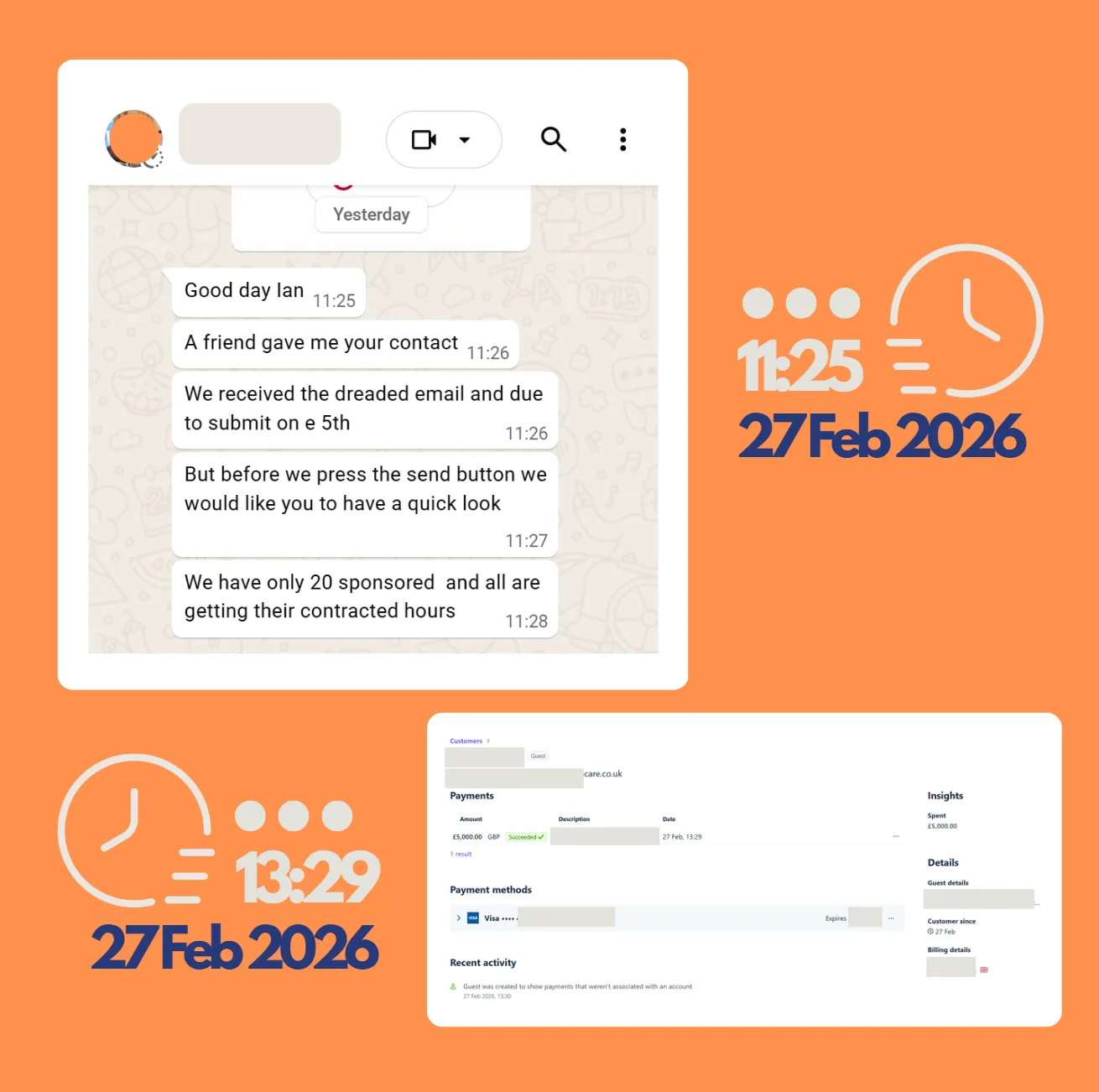
Shortly after the webinar, one attendee introduced Sponsor Complians to a colleague — a domiciliary care provider with 20 sponsored workers. That provider reached out directly with an urgent message:
"We've received the 'We Have Concerns' email from the Home Office. Our deadline to respond is Thursday 5 March 2026. We thought everything was fine. We do not want to lose our licence. We need help immediately."
This is how it typically unfolds. There is no prior warning. The deadline is short — often just days. And the operational pressure is immediate. The Home Office does not provide months to prepare. In most cases, providers are given only days to compile evidence, draft representations, and demonstrate compliance across every area of their sponsor duties.
If this scenario sounds familiar, you are not alone. We have written extensively about what happens when the Home Office initiates contact — from a provider who submitted every document and still had their licence revoked, to a provider whose licence was suspended after a visit but reinstated with a B-rating. The pattern is consistent: the outcome depends entirely on the quality and structure of your response, not just the volume of documents you submit.
When Preparation Meets Timing
The timing proved critical. At the same webinar, Sponsor Complians had announced its Founding Member opportunity for the platform. For this provider, the decision was straightforward — they recognised that structured compliance preparation was no longer optional, and the Founding Member programme offered the most effective route to get there.
The Founding Member programme provides care providers with early access to the Sponsor Complians Hub, including a comprehensive compliance audit and ongoing monitoring — all at preferential terms that will not be available once the programme closes.
- ✅ Priority onboarding with a dedicated compliance specialist
- ✅ Full sponsor compliance audit covering all five duty areas
- ✅ Lifetime founding rate locked in before standard pricing applies
- ✅ Structured Home Office defence framework ready to deploy immediately
The provider engaged Sponsor Complians on 27 February. Within hours, they were fully onboarded and the compliance audit was already underway — well before their Home Office deadline.
What Immediate Action Looks Like
Within 24 hours, the provider received:
Full assessment of every sponsor duty area
Pinpointing exactly where gaps existed
Step-by-step remediation roadmap
Professional response to the Home Office
Every document indexed and cross-referenced
Quality-checked before the 5 March deadline
This is the difference between assuming compliance and proving compliance. When the Home Office raises concerns, reassurance is not sufficient. Evidence is required.
We have seen this pattern repeatedly. In our case study on a provider who submitted every document but still lost their licence, the critical failure was not a lack of documents — it was a lack of structured, targeted evidence that directly addressed the Home Office's specific concerns. Volume alone does not satisfy the Sponsor Licensing Unit.
Why Sponsor Licences Are Lost
Providers who lose their licences are not always negligent. Many simply:
- Rely on fragmented systems — spreadsheets, emails, and paper files that cannot produce a coherent picture under pressure
- Assume someone else is monitoring compliance risk — delegating without oversight or audit trails
- Do not stress-test their compliance framework — never asking "could we prove this to the Home Office today?"
- Wait until the Home Office initiates contact — treating compliance as reactive rather than proactive
By the time a "We Have Concerns" email arrives, the situation has already become reactive. The issue is rarely intention. It is the ability to demonstrate structured, documented compliance under pressure.
This mirrors what we documented in our analysis of West Midlands care providers facing licence revocations — where two providers in the same region, facing similar scrutiny, had dramatically different outcomes based solely on the quality of their compliance infrastructure. The provider with structured systems kept their licence. The one relying on ad-hoc processes lost it.
Similarly, our case note on UKVI salary mismatch concerns demonstrates how a single compliance gap — in that case, a discrepancy between reported and actual salary — can trigger the entire "We Have Concerns" process. These triggers are often smaller than providers expect.
A Critical Question for Every Provider
If a "We Have Concerns" email arrived tomorrow, would your organisation be ready within 48 hours?
If the answer is uncertain, there is exposure. And exposure carries financial, operational, and reputational risk. As we explored in our article on why doing nothing is no longer an option for sponsor licence holders, the cost of inaction now far exceeds the cost of preparation.
Protecting Your Licence Before It's Too Late
For providers who have previously considered a sponsor compliance audit but found the investment prohibitive, the Founding Member programme presents a strategic alternative. It consolidates compliance monitoring, audit preparation, and Home Office defence into a single platform — available at terms that reflect the programme's early-access nature.
The programme is limited and time-bound. Once it closes at the end of March 2026, standard pricing will apply. For providers facing compliance uncertainty, this window represents the most cost-effective route to structured, auditable compliance.
Final Perspective
Sponsor compliance is not something that can be fixed after the email arrives. It is something that must be built before it does.
Care providers who prioritise preparation position themselves not only to protect their licence — but to strengthen their operational resilience and long-term growth. As we have documented across our guidance on Home Office visit preparation and the two questions enforcement officers always ask, the providers who survive scrutiny are those who can demonstrate compliance immediately, not those who scramble to assemble it after the fact.
The Sponsor Complians Hub gives care providers real-time compliance tracking, automated alerts, and structured audit preparation — all in one platform.
Learn more about the Founding Member opportunity →
Get Compliance Updates Straight to Your Inbox
Join care providers who receive our weekly sponsor compliance tips, Home Office policy updates, and practical guidance — free.